Haryanvi Is Not Just a Dialect — It’s a 3000-Year-Old Language That Refused to Die
Someone once told you Haryanvi Language is just a dialect of Hindi. That statement is not entirely wrong but it is not complete either.
Haryanvi is more than a way of speaking. It is a reflection of history, culture and identity that has evolved over centuries. To understand it properly, you have to go beyond labels and look at where it actually comes from. And here is the proof — with facts.
Chapter 1: The Roots — Where It All Began
Haryanvi traces its origins to the ancient Indo-Aryan language family, specifically evolving through Middle Indo-Aryan Prakrits — scholars link its development to Shauraseni Prakrit, which was prevalent in the historical Surasena region encompassing much of modern-day Haryana.
सरल भाषा में — जब तुम्हारा Tau कहता है “कोण्या जावे” — वो actually एक ऐसी language बोल रहा है जिसकी जड़ें 3000+ साल पुरानी हैं।
Shauraseni Prakrit was also the primary language used in medieval North Indian drama, and it later gave rise to languages like Hindi, Gujarati, Rajasthani, and Punjabi. Haryanvi belongs to the same linguistic family.
Chapter 2: Kurukshetra Connection
Haryanvi language has deep roots in the region known as Kurukshetra, the legendary battlefield of the Mahabharata.
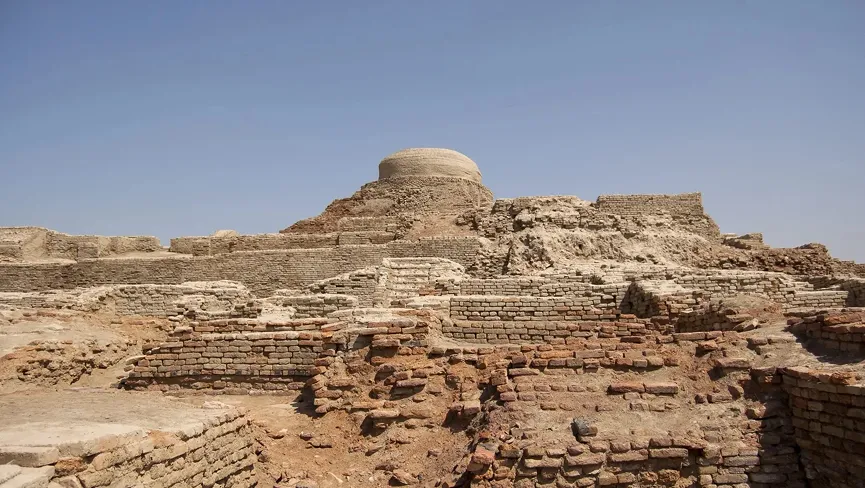
This region was influenced by both pre-Harappan and Harappan civilizations. The Vedas and early scriptures were composed on this very land, where Sanskrit was the dominant language during the Vedic period.
Haryana was also part of the Indus Valley Civilization, with major archaeological sites like Rakhigarhi and Banawali.
This is the land where the Bhagavad Gita was spoken. This is the land where the Vedas were written.
And the language of this land is still called “just a dialect. Think about that.
Chapter 3: Beyond Borders: The Many Forms of Haryanvi
Haryanvi language is not limited to just Rohtak, Sonipat or even present-day Haryana.
It is not a single uniform speech. It is a cluster of closely related dialects and regional variations that spread across multiple states in North India.
Some of the major forms associated with the Haryanvi linguistic group include:
- Bangru – considered the central form spoken in core Haryana regions
- Deshwali – used in rural belts with strong traditional vocabulary
- Bagri – spoken in parts of western Haryana and northern Rajasthan
- Ahirwati (Ahirwal region) – influenced by both Haryanvi and Rajasthani
- Mewati – spoken in Mewat region, with its own distinct phonetic style
- Shekhawati (Sekhawati) – found in Rajasthan, sharing linguistic overlap
- Khari Boli – the base for standard Hindi, historically connected to this region
- Puadhi (Puwadi) – spoken in areas bordering Punjab
- Braj Bhasha – culturally and linguistically linked in nearby regions
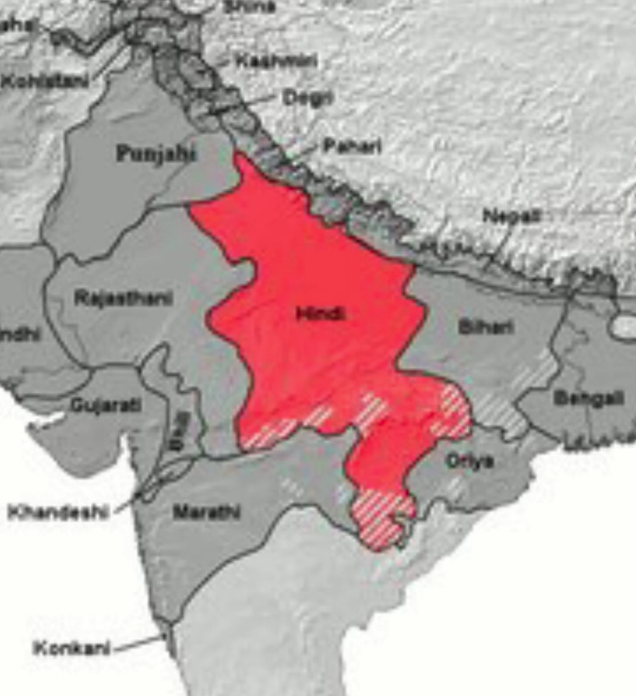
What this shows:
Haryanvi language is not just a “local dialect” of a few districts. It is part of a larger linguistic continuum that stretches across:
- Haryana
- Delhi
- Western Uttar Pradesh
- Northern Rajasthan
- Parts of Punjab
- Some regions of Madhya Pradesh
Each variation has its own tone, vocabulary and cultural context, but they remain interconnected.
In simple terms: Haryanvi is not one voice. It is many voices from the same root.
Chapter 4: Ragini and Saang — When Language Became Performance
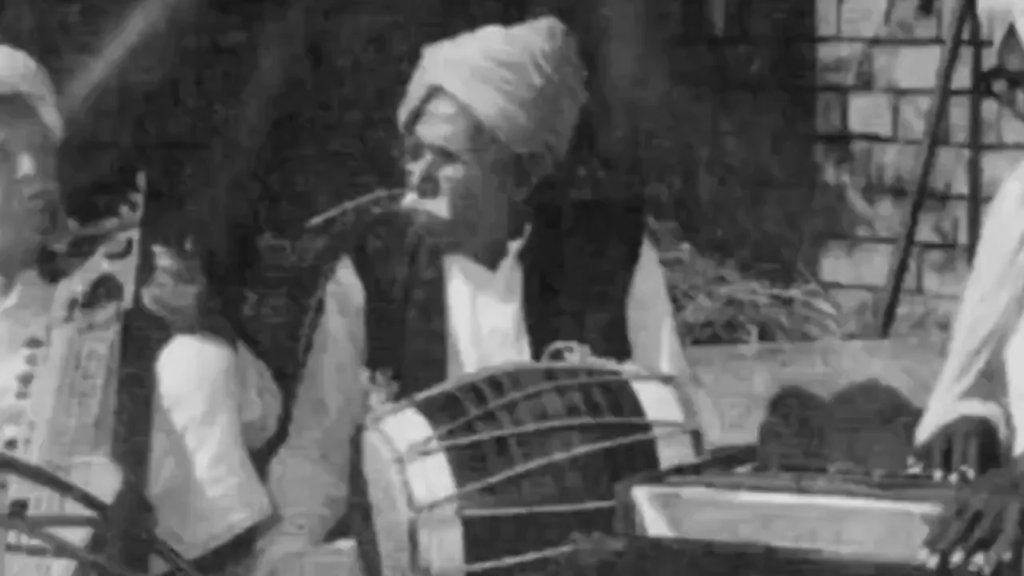
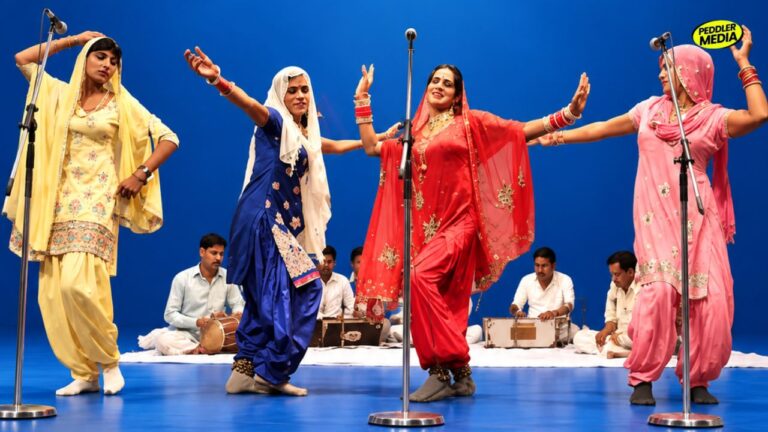
Language was not just spoken here. It was performed. Pandit Lakhmi Chand is known as the “Surya Kavi” and the “Shakespeare of Haryana.” He popularized Ragini and Saang — the two great folk art forms of Haryanvi culture.
Saang is Haryana’s own folk theatre — a form that weaves storytelling with soulful Raginis. Saangi artists delivered social messages through sharp dialogue, humor, and music.
Ragini was traditionally oral. No written records. It passed from generation to generation through performance — covering mythology, socio-political issues, women empowerment, and everyday life.
There was no TV. No radio. No internet. Saang was the only source of public entertainment — and the most effective tool for moral education.
Haryanvi language kept its history, values, and culture alive — entirely through its own voice.
Chapter 5: 1947 Partition and Its Impact
The 1947 Partition of India had a deep impact on Haryanvi language.
After Partition, 1.2 million Haryanvi-speaking Muslims migrated from Haryana and Delhi to Pakistan. Today in Pakistan’s Punjab and Sindh, millions of people still speak Haryanvi as their mother tongue.
The Rangri dialect — spoken by Muslim Ranghars of western Haryana — became extinct inside India after Partition. In Pakistan, it is still spoken and written in the Nastaliq script.
One language. Two countries. Two scripts. One history.
Read More: – 10 Bollywood Movies That Actually Represent Haryanvi
Chapter 6: The Government Game
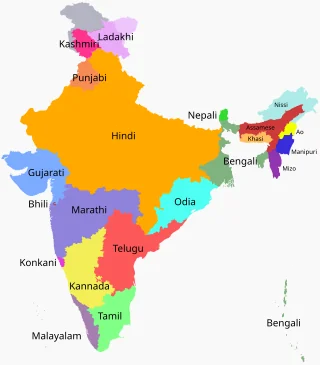
Haryanvi language is classified as part of the Western Hindi dialect group. Its speakers have long demanded recognition as a scheduled language in the Indian Constitution.
The result? No school syllabus. No standard dictionary. No official recognition.
Haryanvi remained a primarily spoken vernacular — deeply embedded in rural and agrarian life. The language that was not in textbooks stayed alive in the hearts of people
Chapter 7: The 90s Identity Crisis
In the 1990s, speaking Haryanvi language in cities was a source of embarrassment.
Go to the city — hide your accent. Speak “shuddh Hindi” in college. Even parents said — “Do not speak Haryanvi, people will think you are uneducated.”
The same language spoken on the land of the Mahabharata was apologizing for its own existence.
Chapter 8: The Revolution — Digital Shift
Then came Bollywood. Dangal, Sultan, and Tanu Weds Manu Returns For the first time, Haryanvi language and culture reached a global audience — and non-native speakers started showing interest in the language.
And then came reels.
The same accent people used to hide became the coolest thing on the internet. Artists started rapping in pure Haryanvi — with no apology.
“Na Ghamand Se, Na Brand Se — Desi Chhoraa Legend Se!”
Chapter 9: Gen Z और Roman Script Problem
Here’s the twist Haryanvi language never had a fixed script. It was always spoken — never standardized.
So Gen Z did what Gen Z does best. They adapted. “Ki haal se?” “Bera konya pata” Not in Devanagari in Roman linguists might panic but the meme hits 2 million views.
Because language doesn’t survive in rules it’s survives in usage and right now — Haryanvi is evolving on its own terms.
Chapter 10: Haryanvi Today
Haryanvi language is spoken today by approximately 10 million people across Haryana, Delhi, Uttar Pradesh, and Rajasthan.
Its folk tradition — Ragini, Saang, Kissa — remains one of the richest oral cultures in North India.
But today, passionate Saangi keep Saang alive while working as construction workers and farm labourers to survive. The language is surviving. But its artists are struggling.
Watch the For Haryanvi, By Haryanvi podcast series by Peddler Media on YouTube.
Next time someone calls Haryanvi language “just a dialect” — put this entire history in front of them.
A language 3,000 years old. The language of the land where the Mahabharata was fought. The land where the Vedas were written. This is not just a dialect.
Follow Peddler Media For More Updates | Instagram | Facebook | Youtube | Pinterest